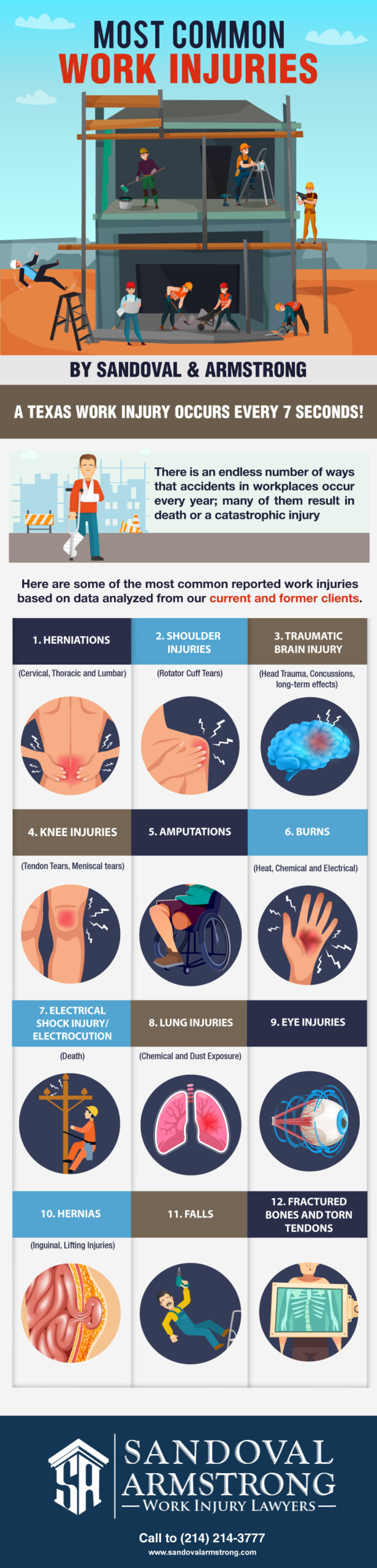


A Texas work injury occurs every 7 seconds! There is an endless number of ways that accidents in workplaces occur every year; many of them result in death or a catastrophic injury while other work accidents result in serious debilitating conditions to the injured worker.
Here are some of the most common reported work injuries based on data analyzed from our current and former clients.
Herniations (Cervical, Thoracic and Lumbar)
Herniations, not to be confused with hernias later on in this list, specifically relate to the back and spinal cord. Herniations occur when the spinal disk shifts out of position and pokes out from between the vertebrae. This can cause severe pain and make moving difficult, as it both puts pressure on the outside of the vertebrae where the herniation is occurring, but also causes the inner part of the vertebrae to rub together since the vertebral disk is now out of place, leaving an area where bone on bone contact can occur. Depending on what section of the spine the herniation occurs in, it can be considered either a cervical (upper), thoracic (middle) or lumbar (lower) spine herniation. Herniations can occur as a result of heavy lifting, lifting with the back rather than the legs, or putting too much strain on the back through improper movements. If you perform a lot of heavy lifting on the job, always practice safe lifting techniques, being sure to lift using your legs rather than your back and consider purchasing a lifting brace to provide additional back support. Herniations are usually treated either through chiropractic treatment if the herniation can be slipped back into place or through surgery depending on the severity of the herniation.
Shoulder Injuries (Rotator Cuff Tears)
Shoulder injuries mostly occur when improperly lifting or overexerting your upper body when lifting. A rotator cuff tear specifically is when the tendons surrounding the shoulder joint are torn. This can lead to shoulder pain, weakness, and a limited range of motion in your shoulder. Rotator cuff tears are primarily caused by repeated motions wearing down or putting excess stress on the tendon. Lifting heavy objects or pulling and pushing heavy equipment can commonly cause rotator cuff injuries. It is important to not overexert yourself and rest if you feel your body getting tired. Also, don’t be ashamed to ask for help lifting something if it is too heavy. Rotator cuff injuries are commonly treated with rest, medications, physical therapy, corticosteroid injections, and in some cases surgery.
Traumatic Brain Injury (Head Trauma, Concussions, long-term effects)
Traumatic brain injuries can be caused by any kind of head trauma. This includes things like falling objects, falls where you strike your head, or something as simple as bumping your head on a bar or a low ceiling when standing up. The effects of a concussion can take months to show, and aren’t always immediate. If you hit your head while on the job, make sure you fill out an accident report and pay attention to any signs of dizziness, disorientation, dry mouth or nausea. These along with memory loss, clouded thinking, and irritability can all be signs of a concussion. There isn’t really a cure for concussions, as the brain will eventually heal over time. The best thing you can do is rest and try to avoid overstimulating your brain. This means cutting back on television and anything with a screen, as the light might cause headaches, as well as cutting back on any sports or physical activities.
Knee Injuries (Tendon Tears, Meniscal tears)
Traumatic brain injuries can be caused by any kind of head trauma. This includes things like falling objects, falls where you strike your head, or something as simple as bumping your head on a bar or a low ceiling when standing up. The effects of a concussion can take months to show, and aren’t always immediate. If you hit your head while on the job, make sure you fill out an accident report and pay attention to any signs of dizziness, disorientation, dry mouth or nausea. These along with memory loss, clouded thinking, and irritability can all be signs of a concussion. There isn’t really a cure for concussions, as the brain will eventually heal over time. The best thing you can do is rest and try to avoid overstimulating your brain. This means cutting back on television and anything with a screen, as the light might cause headaches, as well as cutting back on any sports or physical activities.
Amputations
Severe amputations aren’t very common in your normal retail or business work environment but occur more in factory and manufacturing settings, or in any place where heavy machinery is present. This includes if your workplace has a bailer or trash compactor as well. Amputation is the complete removal of a limb or body part, usually the outer extremities like arms of legs. Amputations can include things like fingers and toes as well though, so kitchen workers who handle sharp knives are also highly at risk if they’re not careful. The loss of a limb or even a finger can be extremely difficult to adjust to, and incredibly painful. If any part of your body is amputated in a workplace accident, immediately call for help and try to find a way to slow the bleeding. If necessary tie a piece of clothing like your shirt or jacket tightly around the edge of the wound to cut off blood flow to the amputated region. Always be careful when working with heavy machinery, and if a piece of equipment is malfunctioning follow the proper lock out tag out system to ensure you don’t risk injury.
Burns (Heat, Chemical and Electrical)
There are a variety of different burn types, each with their own causes. Heat burns are most often caused by contact with hot surfaces, usually caused by touching hot metal or coming in direct contact with fire. These types of burns can vary in severity, minor burns being treatable with cold water and ice packs and more severe burns requiring surgery and medical treatment. Some chemicals like acids can cause burns on the skin and other bodily tissues. Wash the area profusely with water and immediately seek medical attention if any part of your body has come in contact with chemicals that can cause a chemical burn, as residual chemicals can eat at the skin and tissues. Lastly, electrical burns occur after an electrical shock. There are usually two burn locations, one where the electrical current entered the body and one where the current exited the body. You should always seek treatment after an electrical burn as you might also suffer side effects of minor electrocution as well. To prevent burns, always be sure to use the proper personal protective equipment while on the job (insulated gloves and oven mitts in a kitchen setting, latex gloves and lab coats for chemical labs, and rubber gloves appropriate for electrical work).
Electrical Shock Injury/Electrocution (Death)
Electrical shock injuries are common in the maintenance field, especially when working with electrical equipment. Electrical injuries can range from minor shocks and electrical burns to severe electrocution. Even some minor shocks can be dangerous, especially for those with pacemakers as it can throw off the electrical rhythm of the heart if a strong enough shock is delivered. Electrocution can result in serious injury or even death, so prevention is the best cure. Always be aware of your surroundings and cut off all power flow to an area before you begin work. Wear the proper personal protective equipment as well to help keep your body insulated from the electric current. Depending on the voltage you are working with, there are different grades of rubber gloves and boots you can wear that protect from higher ranges of voltages. If you are working on an appliance or machinery, make sure the power supply is removed from the outlet or power source, and use the proper lock out and tag out system to notify others that the machine is not functioning and to avoid using it, especially while you are working.
Lung Injuries (Chemical and Dust Exposure)
Lung injuries are often the hardest to spot or identify, as there isn’t always an immediate sense of danger. Lung injuries are caused by chemicals or other particles being inhaled and entering the lungs. Sometimes once chemicals or particles enter the lungs they become stuck, or adhere to the lungs and do damage to lung tissues. This can include things like asbestos reacting and deteriorating lung tissue, or fungal spores entering the lungs and possibly growing within the bronchiole passageways. If you work in construction, or are working in any area where there is a possibility of airborne contaminants to enter your lungs, always wear some sort of face mask to protect yourself. Symptoms of lung injuries include shortness of breath, excess coughing, and severe chest pains. If you think you may have been exposed to particles that have caused a lung injury, seek medical attention immediately.
Eye Injuries
Our eyes can be very sensitive and relatively exposed organs, and eye injuries can be quite common. Eye injuries are often caused by particles or debris coming in contact with the eye, or in more severe cases having the eye come in contact with a sharp object as the result of a fall. Eye injuries can be somewhat severe, causing scratching of the retina, lens damage, and even puncturing the eye in severe cases. In the case of getting dust or small debris in the eye, do not rub at your eye, but instead, hold your eye open and rinse it under cold running water for 10-20 seconds. Check for any remaining debris and repeat until you’ve washed out the contaminants. In the case of chemicals, rinse your eye until clear, and then seek medical attention. For more severe eye injuries, seek medical attention immediately. To best protect your eyes, always wear protective goggles suitable for the work environment you are in, be it construction goggles or ventilated goggles if working with chemicals. Most goggles provide enough room to wear glasses underneath, but you can also purchase prescription goggles if need be as well.
Hernias (Inguinal, Lifting Injuries)
Hernias are another injury caused by improper lifting techniques and overexertion. A hernia occurs when an internal part of the body, usually the intestine, tears through the omentum lining and presses under the skin. Hernias can usually be seen as a bubble or bulge forming in the lower abdomen, almost looking like a large bubble forming under the skin. If not treated, the tear in the omentum could grow, causing more of your intestine to move out of place, making it more susceptible to injury as well as hindering normal bowel functions. You should seek medical treatment if you have a hernia, and treatment varies depending on the severity of the hernia. Many mild hernias can manually be pushed back into place and the omentum will heal on its own. In more severe cases, the hernia would have to be repaired surgically. Proper lifting techniques and not overexerting your body or lifting more than you can handle are the best ways to prevent hernias while on the job.
Falls
Slip and fall injuries make up 25% of all workplace injuries. No job site is safe from fall injuries, as it can take as something as simple as a misstep to cause a fall. While most falls are minor, hard falls can lead to all sorts of other injuries. This includes torn ligaments, bruising, fractures, head injuries, sprains, and dislocations. If you fall while at work, take a moment to do a self-assessment and make sure you are alright. Have an accident report written and keep track of your condition if you feel well enough to work. To avoid falls, make sure your work area is clear and there isn’t anything on the floor that could get in the way or trip you. Also, be mindful of any cracks or uneven flooring, and if it is a defect in the floor like a peeling rug bring it to maintenance’s attention so that it can be fixed.
Fractured Bones and Torn Tendons
Fractures and torn tendons can take months to heal depending on the how serious the tear or fracture is. These are usually the result of falls, hard impacts with tools or other equipment, or as the result of any other physical force to the body while on the job. This can be from falling debris, accidentally striking yourself with tools like hammers, or simply falling and landing the wrong way. Fractures and torn tendons can be extremely painful, and can severely limit movement. Following the safety precautions and keeping focused on your job can help prevent fractures and tears. Since most fractures are a result of slips and falls, keeping the floor clear of hazards is key to preventing injuries like fractures.
There are a lot of different hazards in the workplace which can cause a lot of injuries. With the right frame of mind and suitable protective equipment, you can help avoid injury and keep yourself safe. If you are injured on the job, speak with your manager and fill out an incident report. That way you’ll be covered by worker’s compensation for related treatments and medical bills that result from your injuries.
Read also:
- Amazon Workers Compensation Claims
- Walmart Workers Compensation Claims
- Target Workers Compensation Claims